
Material deep dive
How engineered quartz is made
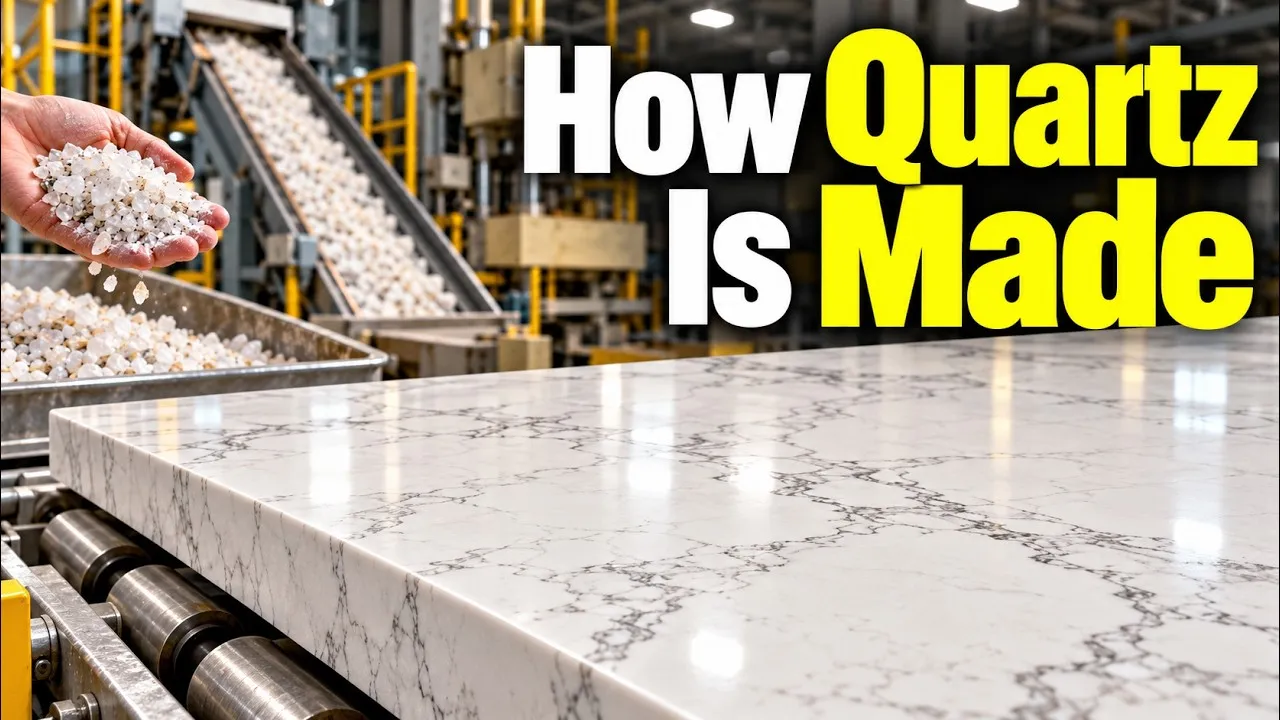
A quartz countertop is not cut from one piece of stone. It is natural quartz that has been crushed, mixed with resin, pressed and polished. Here is how that works, and what it means for your kitchen.
- ≈ 90% mineral by weight in many products; the rest is resin and pigment
- 3 forces vacuum, vibration and pressure pack the slab before it hardens
- 80–100 °C typical curing range (176–212 °F) for polyester-resin quartz
- No coating the gloss comes from polishing with ever-finer diamond abrasives
Step by step · 11 minutes
From crushed quartz to polished slab
Nine stages, each with a link that starts the video at that point. Video by Small Things on YouTube; the summaries are ours.
-
What a quartz slab really is
Quartz is a natural mineral, silicon dioxide. A quartz countertop is not one solid piece of it: it is a composite of crushed mineral bound with a smaller amount of polymer resin and pigment. The factory is not revealing a stone nature finished; it is rebuilding one from chosen ingredients.
Watch from 1:35 -
Crushing and grading
Mined quartz is crushed and screened into coarse grains, medium particles and fine powder. Blending the sizes works like filling a box with tennis balls, then marbles, then sand: each smaller size fills the gaps left by the one before, so the mix packs tightly.
Watch from 2:38 -
Mixing with resin
Measured quartz goes into an industrial mixer with polyester resin, which coats every particle and later locks them together. Pigment keeps the base colour consistent from batch to batch. After about three to five minutes the dry grains have become a damp, cohesive mix.
Watch from 3:47 -
Spreading the layer
The mould is lined with thin polyethylene film so the slab will release cleanly. Hoppers and spreaders level the heavy mix across it, deliberately thicker than the finished slab, because pressing will still squeeze out a lot of empty space.
Watch from 4:52 -
Adding the veins
For a marble look, a contrasting mix is scattered, injected or pushed into the layer in broken, uneven paths. When the colour runs into the body of the slab, the vein can carry on along a cut or polished edge. Small variations keep slabs from looking machine-made.
Watch from 6:00 -
Vacuum, vibration and pressure
In a sealed chamber, vacuum draws out trapped air that could become pores, vibration lets the particles settle into tighter positions, and pressure compacts the layer. Over a few minutes the slab becomes much denser and thinner. This step is where quartz gets its non-porous surface.
Watch from 7:10 -
Curing in the oven
Pressure gives the slab its density; heat makes it stay that way. A curing oven at roughly 80 to 100 °C (176 to 212 °F) sets the resin over about 15 minutes to an hour, depending on the formula, and the slab is then cooled under control.
Watch from 8:14 -
Calibrating and polishing
Water-cooled diamond saws trim the slab to size. A line of polishing heads with progressively finer diamond abrasives removes the scratches left by the stage before, which is what creates the shine. Cameras, sensors and people checking under strong light look for cracks, air pockets and uneven areas.
Watch from 9:16 -
Packing and shipping
A protective film goes on the polished face, and slabs travel standing up in racks or A-frames with soft pads and straps, never stacked flat. A finished slab can be more than 5 feet wide and 10 feet long.
Watch from 10:21
In your kitchen
What the process means for your countertop
The way quartz is made explains both its strengths and its limits. Each point links back to the stage it comes from.
-
No sealing
Vacuum pressing and resin leave very few pores, so most food stains wipe away and the surface never needs sealing. Strong dyes, permanent marker and some chemicals can still leave marks.
From step 6: vacuum, vibration and pressure -
Consistent colour
Graded particles and measured pigment make one slab look much like the next, which helps when you need to match several rooms. The flip side is that patterns repeat rather than being one of a kind.
From step 3: mixing with resin -
Veins and edges
Whether the veining runs through the body of the slab or mostly sits near the surface affects how an edge profile or mitred edge will look. Ask to see an edge sample.
From step 5: adding the veins -
Heat is the weak point
The resin that binds the slab is also its limit. Hot pans, slow cookers and some appliances can scorch or discolour it, so trivets are essential. Each manufacturer publishes its own temperature limits.
From step 7: curing in the oven -
Mostly for indoors
Resins can discolour in direct sunlight, so most engineered quartz is meant for indoor use. Check the manufacturer before planning an outdoor kitchen or a sunny window run.
From step 3: mixing with resin -
Gentle cleaning
Soap and water or a mild cleaner is all it needs. Bleach, oven cleaner, solvents and strongly alkaline products can damage the resin, and the brand’s care sheet usually decides the warranty.
From step 3: mixing with resin
Easily confused
Engineered quartz is not quartzite
The names are close and both are mostly quartz, but one is made in a factory and the other is quarried. They are cared for and priced differently.
| Property | Engineered quartz | Quartzite |
|---|---|---|
| What it is | Factory-made composite of crushed quartz, resin and pigment | Natural metamorphic rock: sandstone fused by heat and pressure |
| Each slab | Consistent; patterns repeat | Unique; colour and veining vary slab to slab |
| Sealing | Never needed | Usually needed; how often depends on the slab |
| Heat | Weakest point: resin can scorch or discolour | Generally tolerates heat well; trivets still advised |
| Acids | Not etched by food acids; harsh chemicals can harm the resin | True quartzite does not etch; some stones sold as quartzite can |
| Outdoors | Usually indoor only (sunlight can discolour resin) | Often suitable; check the specific stone |
Keep reading
Related guides
Start a conversation
Deciding between quartz and natural stone?
Tell us how you cook, where the countertop is going and the look you are after, and we will help you weigh the options.